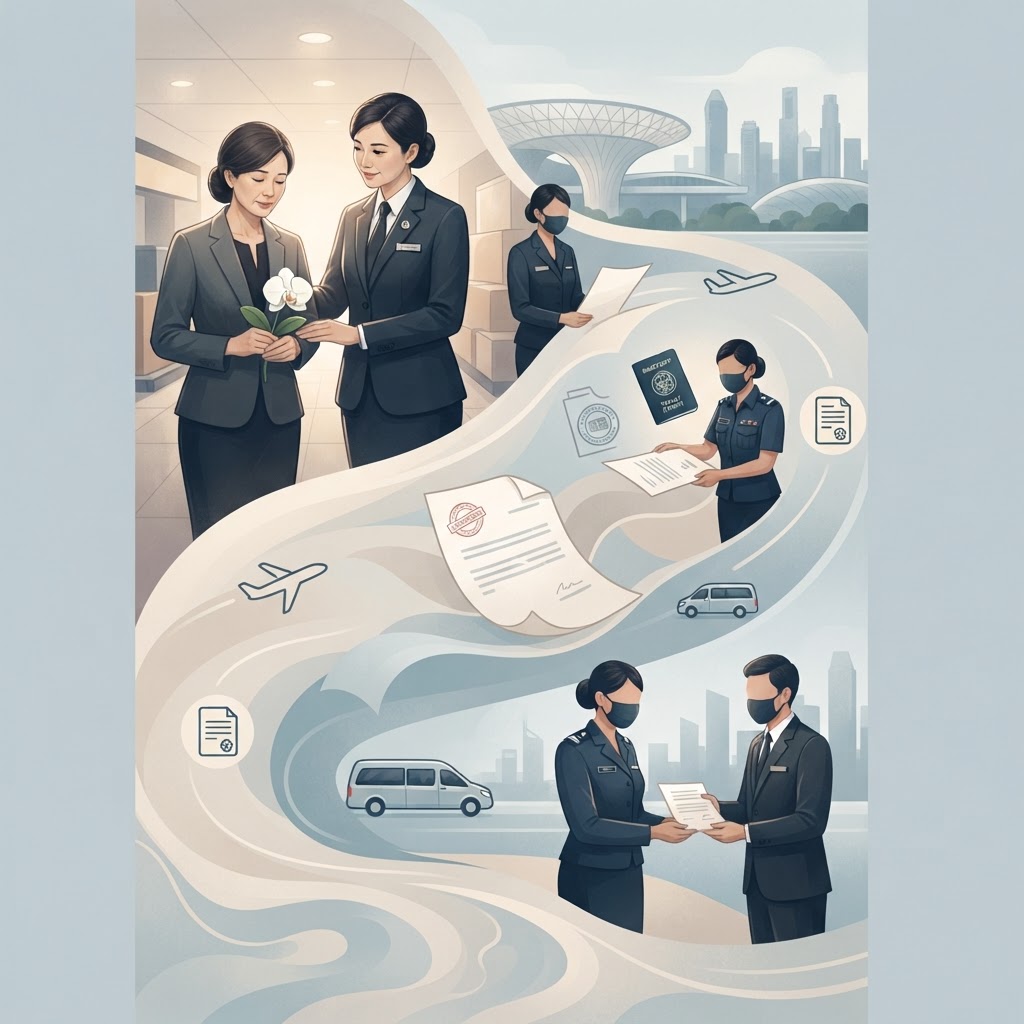
Customs Clearance for Human Remains Entering Singapore: A Compassionate, Step-by-Step Guide Families Can Trust
When grief arrives from overseas, it rarely arrives alone. It brings urgent phone calls, unfamiliar paperwork, embassy coordination, airline rules, and one pressing question that families often ask in a trembling voice: “How do we bring our loved one home to Singapore properly?”
At Eternal Horizon, we understand that customs clearance for human remains entering Singapore is not just a logistics issue. It is a deeply personal journey of dignity, timing, faith, family, and care. Behind every document is a name. Behind every flight is a farewell. And behind every smooth arrival is careful planning carried out with compassion.
This guide explains the process clearly, accurately, and gently—so you know what to expect, what documents are needed, how transportation works, and how professional support can ease the burden.
Why customs clearance matters so much
When human remains are repatriated into Singapore, the arrival cannot be handled like ordinary cargo. There are strict health, documentation, airline, and receiving procedures that must be followed carefully.
Done correctly, customs and arrival clearance helps ensure:
- The deceased is transported with dignity
- Documents are properly verified
- Delays at the airport are minimized
- The receiving funeral arrangements in Singapore can proceed smoothly
- Families are protected from avoidable administrative stress
In other words, proper clearance is the bridge between an overseas loss and a peaceful homecoming.
First, understand the two main transport scenarios
Although this article focuses on entering Singapore, many families also ask about onward or related repatriation arrangements from Singapore. One of the most important distinctions is the mode of transport.
1) Repatriation involving West Malaysia: usually by land
For West Malaysia, transport is typically handled by land using a refrigerated hearse. This is often the practical choice due to proximity and route accessibility.
2) Repatriation involving East Malaysia and overseas destinations: usually by air freight
For East Malaysia, India, China, the Philippines, the UK, Australia, and other longer-distance destinations, transport is usually by air freight, commonly booked under HUM (human remains) handling procedures.
This distinction matters because documents, timing, handling procedures, and costs can differ significantly between land transport and air freight.
Step-by-step: customs clearance for human remains entering Singapore
Below is the typical process when a loved one is being brought into Singapore from overseas.
1. Collect and verify the essential overseas documents
Before departure, the documents issued in the country of death must be checked carefully. Requirements can vary depending on the country of origin and the circumstances of death, but families will generally need:
- Official death certificate
- Cause of death certificate or medical certificate
- Embalming certificate if embalming was performed
- Sealing certificate for the coffin/casket where applicable
- Permit for export or transit documents from the sending country, if required
- Passport or identification details of the deceased
- Flight and air waybill details for air transport
A funeral director experienced in repatriation will review these documents early to reduce the risk of last-minute airport issues.
Why document accuracy is crucial
Even a minor mismatch—such as a name spelling inconsistency, passport number error, or missing supporting certificate—can cause delays. In repatriation, small details matter enormously.
2. Confirm Singapore receiving arrangements before departure
Before the remains depart for Singapore, the receiving side should already be organized. This usually includes:
- A local funeral director in Singapore
- A receiving location such as a funeral home, place of worship, or other approved venue
- Coordination of airport collection
- Planning for wake, cremation, or burial arrangements
At Eternal Horizon, we typically coordinate these elements before the flight lands, so the family is not left making urgent decisions at the airport.
3. Airline and cargo booking for human remains
For air arrivals into Singapore, human remains are usually moved through air cargo handling, not standard passenger baggage procedures.
This involves:
- Booking under the airline’s human remains / HUM protocol
- Confirming coffin specifications and documentation requirements
- Ensuring the remains are accepted by the airline before departure
- Coordinating cargo terminal release on arrival in Singapore
Important note on coffin choice for air freight
For air freight destinations, freight charges are generally calculated based on the overall weight of the shipment.
That means families may choose a simple, lightweight coffin for the flight to reduce air freight costs significantly. If preferred, the family can then change to a different coffin upon arrival at the destination for the final wake, viewing, burial, or other funeral rites.
This is a practical option many families are grateful to know about, especially when balancing tradition, presentation, and budget.
4. Arrival in Singapore and customs-related release procedures
Once the remains arrive in Singapore, the shipment must go through the relevant airport cargo and release procedures before transfer can take place.
This stage may involve:
- Verification of shipping and identification documents
- Coordination with the cargo terminal
- Checking that all required permits and certificates are in order
- Arranging the release to the appointed funeral director or transporter
While families often refer to this entire stage as “customs clearance”, in practice it typically includes a combination of cargo handling, documentation checks, and regulated release procedures.
The key is proper pre-planning: when everything is prepared in advance, the arrival process is usually much smoother and less distressing.
5. Transfer from the airport with dignity and care
After release, the remains are transferred respectfully by the receiving funeral team in Singapore.
Depending on the family’s wishes, this may be directly to:
- A funeral parlour
- A wake venue
- A place of worship
- A crematorium or burial preparation venue
- A private holding facility where appropriate
Every transfer is handled with solemnity, discretion, and care.
A simple timeline families can expect
| Stage | What happens | Typical focus | |---|---|---| | Overseas preparation | Documents, embalming/sealing, export arrangements | Accuracy and compliance | | Transport booking | Airline or route coordination | Correct handling mode | | Departure | Remains leave origin country | Secure transit | | Arrival in Singapore | Cargo/document release procedures | Clearance and collection | | Local transfer | Hearse transfer to receiving venue | Dignity and continuity | | Final arrangements | Wake, cremation, burial, religious rites | Family support |
Actual timelines vary depending on country of origin, flight schedules, local authority procedures, weekends/public holidays, and document readiness.
What documents should families prepare on the Singapore side?
Although every case is different, it is wise to have the following ready where applicable:
- Name and identification details of the next of kin
- Contact details of the receiving family representative
- Funeral director’s contact details
- Flight or cargo arrival information
- Final arrangement preferences (wake, cremation, burial, religious requirements)
A professional repatriation team can advise if anything additional is needed based on the origin country.
How are repatriation and clearance costs calculated?
Because every case is unique, responsible funeral directors should not quote misleading “one-price-fits-all” figures.
Instead, costs are generally calculated based on factors such as:
- Country of origin
- Distance and transport mode
- Airline or cargo handling requirements
- Overall shipment weight for air freight
- Coffin type and dimensions
- Embalming and preparation requirements
- Documentation and legalization needs
- Airport, cargo, and handling charges
- Local receiving arrangements in Singapore
- Religious or ceremonial preferences
A valuable cost-saving insight for air freight cases
For cases traveling by air freight (HUM), the overall weight can make a meaningful difference to cost. Choosing a lightweight flight coffin can reduce freight charges, and families may later select a different coffin after arrival if they wish.
This allows a respectful balance between practical cost management and meaningful final tribute.
Common situations where delays happen
Delays are most often caused by one or more of the following:
- Incomplete overseas documents
- Name mismatches across certificates and passport records
- Airline acceptance issues
- Last-minute routing changes
- Public holiday closures or limited processing hours
- Delays in embalming, sealing, or export permits at origin
This is why experienced coordination matters so much. A calm, methodical team can often prevent problems before they happen.
Family checklist: what to do first
If your loved one has passed away overseas and must be brought into Singapore, start here:
- Inform the hospital, local funeral home, or authorities that repatriation to Singapore is intended
- Secure the death certificate and medical documents
- Contact an experienced repatriation funeral director in Singapore immediately
- Share a clear copy of all available documents for review
- Confirm the family representative and contact number
- Discuss the preferred final arrangements in Singapore
- Check whether the case will involve land transfer or air freight
- Ask about coffin options for weight management in air freight cases
FAQ: customs clearance for human remains entering Singapore
How long does customs clearance take?
It depends on the origin country, flight schedule, cargo handling procedures, and document completeness. When paperwork is properly prepared, delays are often reduced significantly.
Can family members collect the remains directly from the airport?
In most cases, it is best handled by the appointed funeral director or professional receiving team familiar with cargo release procedures and respectful transfer protocols.
Is embalming always required?
Requirements depend on the origin country, airline rules, transit conditions, and receiving arrangements. The sending and receiving funeral directors will advise based on the case.
What is the difference between land and air repatriation?
For West Malaysia, repatriation is usually by land using a refrigerated hearse. For East Malaysia and countries such as India, China, the Philippines, the UK, and Australia, it is usually by air freight (HUM).
When families need more than logistics, they need steady hands
In the middle of loss, forms and freight rules can feel painfully impersonal. But the truth is, a well-managed repatriation is one of the final acts of love a family can give: bringing someone home carefully, lawfully, and with dignity.
At Eternal Horizon, we combine international repatriation expertise with compassionate funeral care, guiding families through customs clearance for human remains entering Singapore with clarity, discretion, and respect at every step.
If you need immediate help, we are here 24/7.
WhatsApp Eternal Horizon now: +65 8111 1826
We will help you understand the process, review the documents, coordinate the arrival, and support your family from the first call to the final farewell.