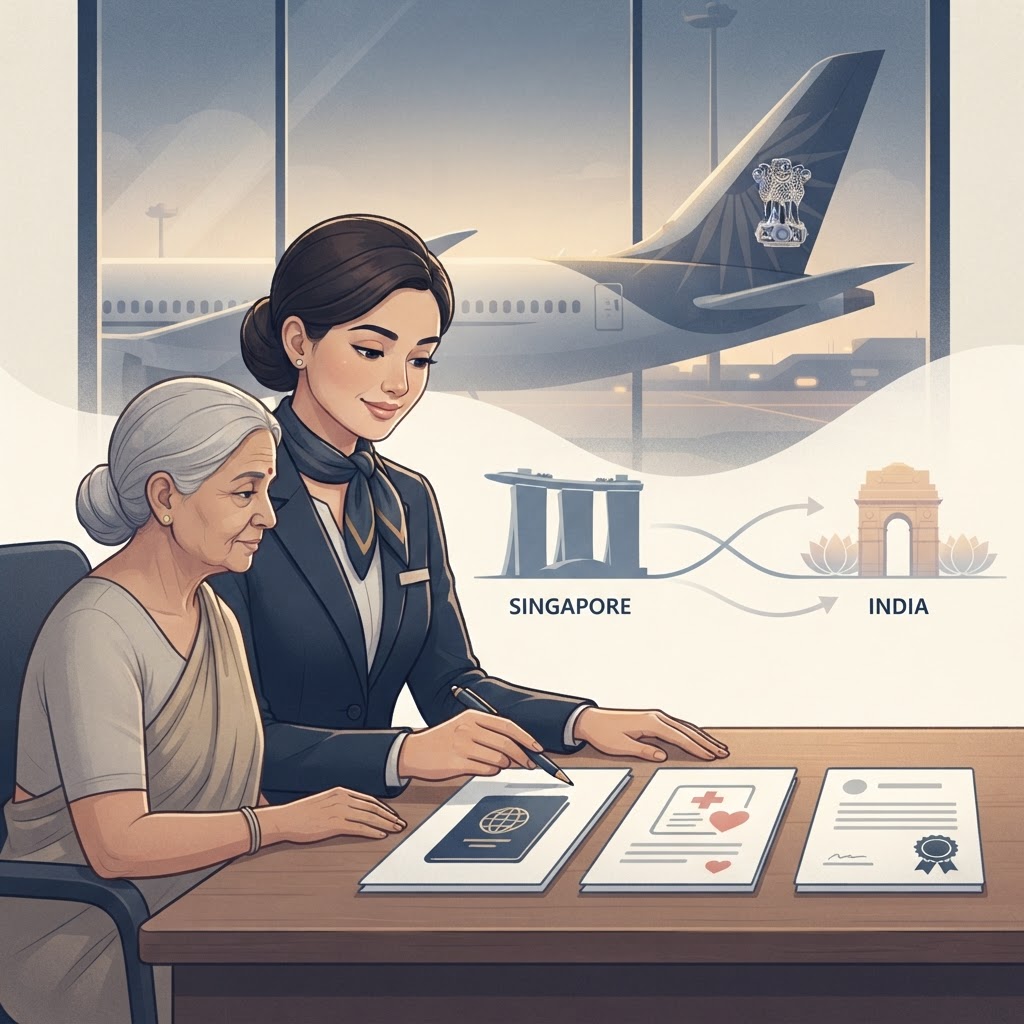
Document Requirements for Transporting Deceased from Singapore to India: A Clear, Compassionate Family Guide
When a loved one passes away overseas, grief is often followed by a wave of urgent questions. What happens next? Which documents are needed? How quickly can we bring them home? For Indian families in Singapore, the process of returning a loved one to India can feel overwhelming at first—but with the right guidance, it becomes far more manageable.
At Eternal Horizon, we walk families through every stage of repatriation with dignity, precision, and compassion. In this guide, we explain the document requirements for transporting deceased from Singapore to India, what the process looks like, how timelines usually work, and what families should prepare for when arranging air freight repatriation.
Why Repatriation to India Requires Careful Documentation
Unlike local funeral arrangements, international repatriation involves multiple authorities, airline regulations, health requirements, and receiving-country procedures. For India-bound cases from Singapore, transportation is typically done by air freight, not by land. In airline systems, human remains are commonly handled as HUM cargo.
That means the paperwork must be complete, accurate, and aligned across:
- Singapore authorities
- The airline or cargo handler
- The Indian Consulate/High Commission where applicable
- Authorities and receiving funeral agents in India
Even one missing or inconsistent document can cause delays. That is why careful professional coordination matters so much.
Air Freight vs Land Transport: An Important Distinction
Before we go into the documents, families often ask how international transport is actually arranged.
For Malaysia (West Malaysia)
Repatriation is usually done by land, typically using a refrigerated hearse.
For India, East Malaysia, China, Philippines, UK, Australia, and similar destinations
Repatriation is usually done by air freight (HUM).
For India, this means the deceased is prepared according to airline and destination requirements, placed in an approved coffin or casket setup, and booked on a suitable flight route to the receiving airport in India.
Main Document Requirements for Transporting Deceased from Singapore to India
While exact requirements may vary slightly depending on the airline, destination airport, and circumstances of death, the following documents are commonly required.
Core documents usually needed
| Document | What It Is | Why It Matters | |---|---|---| | Death Certificate | Official certificate issued in Singapore | Confirms the death legally | | Cause of Death Certificate / Medical Certification | Medical confirmation of cause of death | Required for health and clearance purposes | | Embalming Certificate | Certificate confirming embalming has been completed | Commonly required for international air transport | | Coffin Sealing Certificate | Certification that the coffin has been properly sealed | Helps meet airline and transport regulations | | Passport of the Deceased | Original passport, usually for cancellation and identification | Needed for identity verification and travel documentation | | ID/Passport of Next of Kin | Identification of the authorising family member | Confirms legal authority and relationship | | Authorisation Letter from Next of Kin | Written consent appointing the funeral director/repatriation team to act | Allows documentation and shipment arrangements | | Airway Bill / Cargo Booking Documents | Airline cargo transport paperwork | Required for HUM air freight handling | | Consular or Embassy Documentation | Documentation required by Indian authorities/mission if applicable | May be needed depending on case specifics | | Receiving Party Details in India | Name, address, ID, and contact of the person/funeral provider receiving the deceased | Needed for customs, airport release, and onward arrangements |
Additional documents that may be required in some cases
Depending on the case, authorities may also request:
- Police reports, if the death was sudden, accidental, or under investigation
- Hospital reports or post-mortem documents
- Cremation or burial permit requirements at destination
- Local municipal or airport clearance in India
- Translation or notarisation in rare cases if requested by receiving authorities
Because each case is unique, families should never rely on a generic checklist alone. Professional verification is essential before the shipment is confirmed.
Step-by-Step: How the Repatriation Process Usually Works
What feels most stressful for families is often not just the grief—but the uncertainty. Here is how the process usually unfolds.
1. Immediate notification and family authorisation
Once the death has occurred, the family or institution contacts a funeral director experienced in international repatriation. The next of kin provides initial instructions and authorisation.
2. Registration of death in Singapore
The death must be formally registered, and the official death certificate must be obtained.
3. Preparation of the deceased
For transport to India by air freight, the deceased is usually prepared through embalming and placed in a coffin suitable for international transport, in line with airline and destination requirements.
4. Document compilation and verification
All medical, legal, airline, and receiving-country documents are gathered and checked carefully. This is one of the most important stages.
5. Airline cargo booking
The repatriation team books the shipment as HUM air cargo, coordinating route availability, cut-off times, and destination handling.
6. Departure clearance from Singapore
Once approvals and bookings are in place, the coffin is transferred for export handling and uplift on the booked flight.
7. Arrival and release in India
At the destination airport, local clearance procedures take place before the deceased is released to the family or receiving funeral provider for final rites.
Typical Timeline at a Glance
Every case differs, but the table below gives families a realistic view of how the process is often organised.
| Stage | Typical Focus | |---|---| | Day 1 | Death registration, family instructions, initial document gathering | | Day 1–2 | Preparation of the deceased, embalming, coffin arrangements | | Day 2–3 | Document verification, airline cargo booking, export coordination | | Next available flight | Air freight departure from Singapore | | Upon arrival in India | Airport clearance and release to receiving party |
Actual timing depends on:
- How quickly documents are issued
- Whether the case involves hospital, police, or coroner procedures
- Airline space availability
- Destination airport processes in India
- Public holidays or consular operating hours
How Air Freight Costs Are Calculated
Families naturally want to understand cost, especially when planning under emotional pressure. It is important to know that air repatriation costs are not fixed, and responsible funeral directors should avoid giving misleading one-size-fits-all figures.
For transport from Singapore to India by air freight, costs are generally influenced by:
- Overall shipment weight
- Coffin or casket type
- Preparation requirements, including embalming and sealing
- Airline routing and cargo availability
- Export documentation and handling charges
- Arrival arrangements and local receiving services in India
A practical way families may save on air freight
Because air freight charges are commonly based on overall weight, families may choose a simple, lightweight coffin for the international flight. This can significantly reduce air cargo costs.
If preferred, the family can then change to a different coffin upon arrival in India for the final funeral rites. This is a practical option many families appreciate once they understand how air freight pricing works.
A Helpful Family Checklist
To help things move smoothly, prepare these items early if possible:
- Original passport of the deceased
- ID/passport of next of kin
- Contact details of family members in India
- Receiving address and funeral arrangements in India, if already known
- Any hospital or medical documents available
- Police or investigation documents, if applicable
- Preferred airport/city in India for arrival
If you do not have every document immediately, do not panic. An experienced repatriation team can advise what must be obtained first and what can be coordinated in parallel.
FAQ: Document Requirements for Transporting Deceased from Singapore to India
Is embalming required for transport from Singapore to India?
In most air repatriation cases, embalming is typically required to meet airline and international transport requirements.
Can the deceased be sent to any city in India?
In many cases, yes—but routing depends on airline cargo operations, airport capabilities, and the receiving arrangements in that city.
Do families need to handle all documents themselves?
Usually, no. A professional repatriation provider can coordinate and prepare most of the required documentation, while guiding the family on the documents only they can provide.
What if the death was sudden or under investigation?
Additional procedures and documents may be required, including police or medico-legal clearance. This can affect the timeline.
When Compassion Matters as Much as Paperwork
Behind every document is a loved one, a family, and a final journey that deserves great care. The document requirements for transporting deceased from Singapore to India are important—but so is having someone by your side who can handle the details calmly, respectfully, and correctly.
At Eternal Horizon, we support families 24/7 with professional repatriation coordination, careful documentation, and compassionate guidance from Singapore to India.
Need immediate help? Contact Eternal Horizon on WhatsApp at +65 8111 1826 for urgent 24/7 assistance.