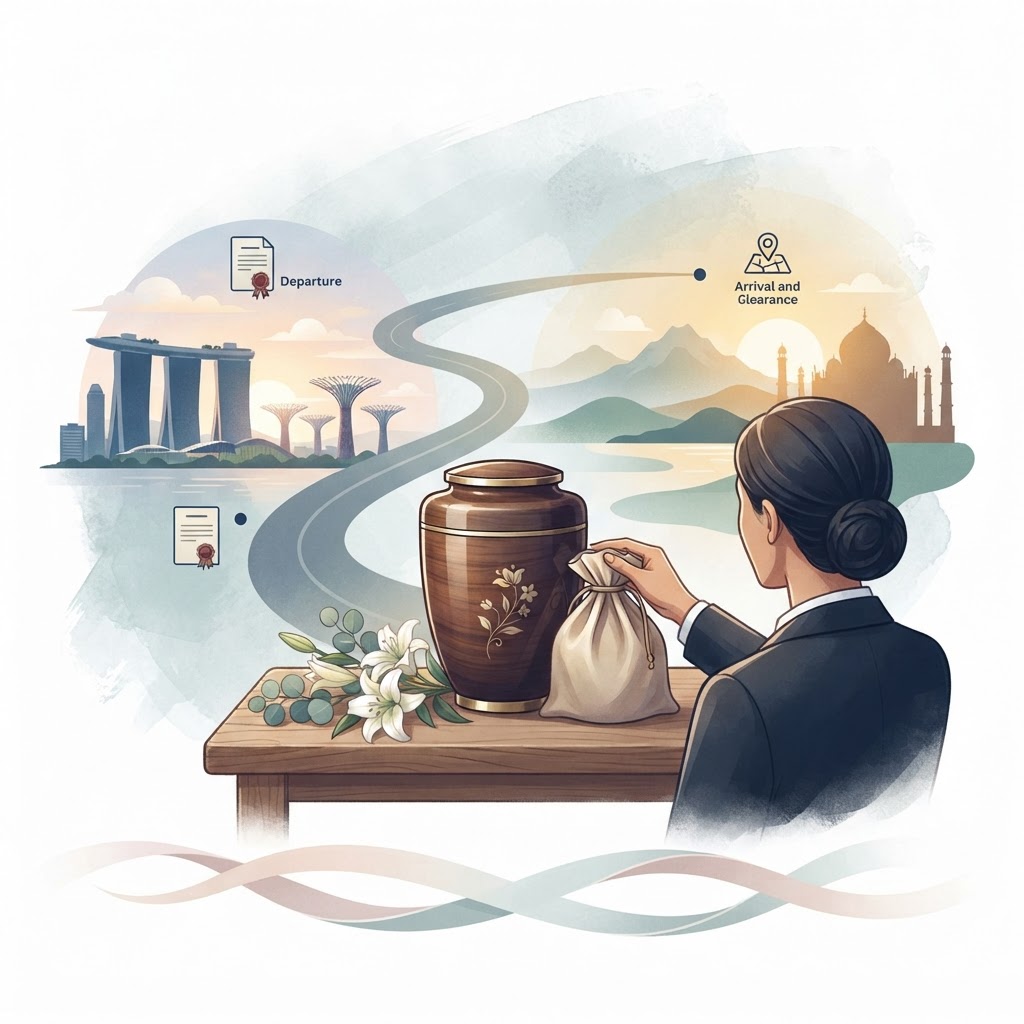
How to Repatriate Ashes from Singapore to India: A Calm, Clear Guide for Families
When a loved one’s final journey needs to cross borders, families are often carrying two heavy burdens at once: grief and paperwork. In those first difficult hours, a simple question can feel overwhelming: how do you repatriate ashes from Singapore to India safely, legally, and respectfully?
The good news is that transporting cremated remains is usually more straightforward than many people fear—when it is handled correctly. With the right documentation, careful packing, and proper coordination with the airline and receiving family in India, the process can be dignified, smooth, and free from unnecessary stress.
At Eternal Horizon, we support families in Singapore with compassionate, professional guidance around the clock. In this guide, we explain exactly how to repatriate ashes from Singapore to India, what documents are usually needed, how timelines work, and how costs are generally calculated.
Why Families Repatriate Ashes to India
For many families, bringing ashes home is about far more than transport. It is about:
- honouring religious or cultural rites
- allowing final prayers or ceremonies in the hometown
- fulfilling a loved one’s final wishes
- enabling immersion or memorial rites in a meaningful place
- giving relatives in India a chance to gather and say goodbye
In Indian families especially, final rites may be deeply connected to place, tradition, and timing. That is why the repatriation process must be handled with both precision and care.
Ashes Repatriation vs. Full Body Repatriation: An Important Difference
Before we go further, it helps to understand that ashes repatriation is not the same as repatriating a deceased person’s body.
If the remains are cremated ashes
Transport is usually simpler. The ashes are typically carried by:
- airline checked baggage or hand-carry, subject to airline rules and destination requirements
- sometimes cargo arrangements, depending on circumstances and airline procedures
If the remains are a deceased person being sent overseas
Transport depends on destination:
- West Malaysia: usually by land transport in a refrigerated hearse
- East Malaysia, India, China, Philippines, UK, Australia, and other overseas destinations: usually by air freight (HUM)
For air freight (HUM) cases, charges are generally calculated based on overall weight. Families can often reduce air freight cost by choosing a simple, lightweight coffin for the flight, and then changing to a different coffin after arrival if they prefer.
That weight-based air freight principle is important in full body repatriation—but for ashes to India, the process is usually lighter, faster, and administratively simpler.
How to Repatriate Ashes from Singapore to India: Step by Step
Here is the process families typically follow.
1. Obtain the cremation and death documents
The first essential step is gathering the official paperwork. This commonly includes:
- Death Certificate
- Cremation Certificate
- identification details of the deceased
- passport copy or other supporting identity records, where available
Depending on the airline or receiving authorities, additional documents may sometimes be requested.
2. Place the ashes in a suitable urn or container
For travel, the ashes should be packed in a secure, sealed container. In many cases, a non-metallic urn or a travel-friendly container is advisable because airport screening may require the contents to be scanned.
A practical container should ideally be:
- properly sealed
- durable and protected from breakage
- clearly labelled
- easy to present for inspection if requested
3. Check airline requirements before travel
This is one of the most important steps. Different airlines can have different rules about:
- whether ashes may be hand-carried
- whether ashes must be placed in checked baggage
- document presentation at check-in
- container requirements
Because policies can vary, families should always verify airline rules before departure rather than assume all airlines handle cremated remains the same way.
4. Confirm entry expectations on the India side
Requirements can differ depending on the airport, airline routing, and local handling procedures. In many cases, families traveling with cremated remains should carry:
- original death certificate
- original cremation certificate
- passport and travel documents of the accompanying person
- any additional supporting letter if requested
While cremated remains are generally easier to transport than full-body repatriation, proper paperwork remains essential to avoid delays.
5. Travel with the ashes respectfully and securely
On the day of departure, it is wise to:
- arrive at the airport early
- keep all original documents together in a clear folder
- inform the airline staff politely at check-in
- ensure the urn/container is packed in a stable, respectful manner
6. Receive the ashes in India and proceed with final rites
Once in India, the ashes can be taken by the family for the intended ceremony, memorial, or immersion rites, subject to local customs and any local regulations.
A Simple Timeline Families Can Expect
| Stage | What Happens | Typical Consideration | |---|---|---| | Document collection | Death and cremation records are gathered | Must be complete and consistent | | Urn preparation | Ashes are sealed for transport | Travel-friendly container is best | | Airline coordination | Carrier rules are checked and confirmed | Policies vary by airline | | Departure from Singapore | Ashes travel with accompanying family member or as arranged | Keep originals on hand | | Arrival in India | Documents may be reviewed if requested | Smooth handling depends on proper preparation |
Documents Checklist
Use this practical checklist before departure:
| Document / Item | Why It Matters | |---|---| | Death Certificate | Confirms the death officially | | Cremation Certificate | Confirms the remains are cremated ashes | | Deceased’s identification details | Supports identity verification | | Accompanying traveler’s passport | Needed for travel and presentation | | Airline booking details | Helps coordinate check-in requirements | | Properly sealed urn/container | Ensures safe and respectful transport |
How Costs Are Calculated
One of the most common questions families ask is: how much does it cost to repatriate ashes from Singapore to India?
Because every case is different, it is not responsible to quote a one-size-fits-all figure. Costs are usually influenced by factors such as:
- document preparation requirements
- type of urn or travel container selected
- whether professional collection, packing, and coordination are needed
- airline route and baggage rules
- urgency of travel arrangements
- whether additional consular or administrative support is required
If a family is comparing ashes transport with full body repatriation, remember that full body air freight (HUM) costs are generally weight-based. In such cases, using a simple, lightweight coffin for the flight can significantly reduce air freight charges, with the option to change coffins after arrival.
Common Mistakes Families Should Avoid
Even simple repatriation can become stressful if small details are missed. The most common issues include:
- turning up at the airport without checking airline policy
- carrying incomplete or inconsistent documents
- using an urn that is difficult to screen or unsuitable for travel
- assuming procedures are identical for every country and airline
- making last-minute arrangements during an already emotional time
A professional repatriation team helps prevent exactly these problems.
How Eternal Horizon Supports Families
At Eternal Horizon, we know this is not just logistics—it is a loved one’s final homecoming.
We assist families with:
- clear guidance on the ashes repatriation process
- document review and preparation support
- travel-ready packing advice
- coordination with airlines and relevant parties where needed
- compassionate updates throughout the process
- urgent 24/7 assistance for time-sensitive cases
Our role is to reduce uncertainty, protect dignity, and help families move forward with peace of mind.
FAQ: How to Repatriate Ashes from Singapore to India
Can I carry ashes on a flight from Singapore to India?
Often yes, but it depends on the airline’s policy and proper documentation. Always confirm with the airline before travel.
What documents are usually needed?
Typically, the death certificate and cremation certificate are essential, along with the traveler’s passport and supporting identification details.
Is ashes repatriation easier than full body repatriation?
Yes, in most cases it is much simpler. Full body repatriation usually involves more documents, airline cargo procedures, and for overseas destinations like India, transport is generally by air freight (HUM).
How long does the process take?
It depends on how quickly documents are ready and the travel arrangements are confirmed. Good preparation helps avoid delays.
A Final Word for Families
In times of loss, even a small task can feel enormous. But with the right support, repatriating ashes from Singapore to India can be handled calmly, respectfully, and correctly.
If your family needs immediate guidance, Eternal Horizon is here to help—day or night, with compassion and professionalism.
WhatsApp us anytime at +65 8111 1826 for 24/7 assistance.
Your loved one’s final journey deserves care at every step.