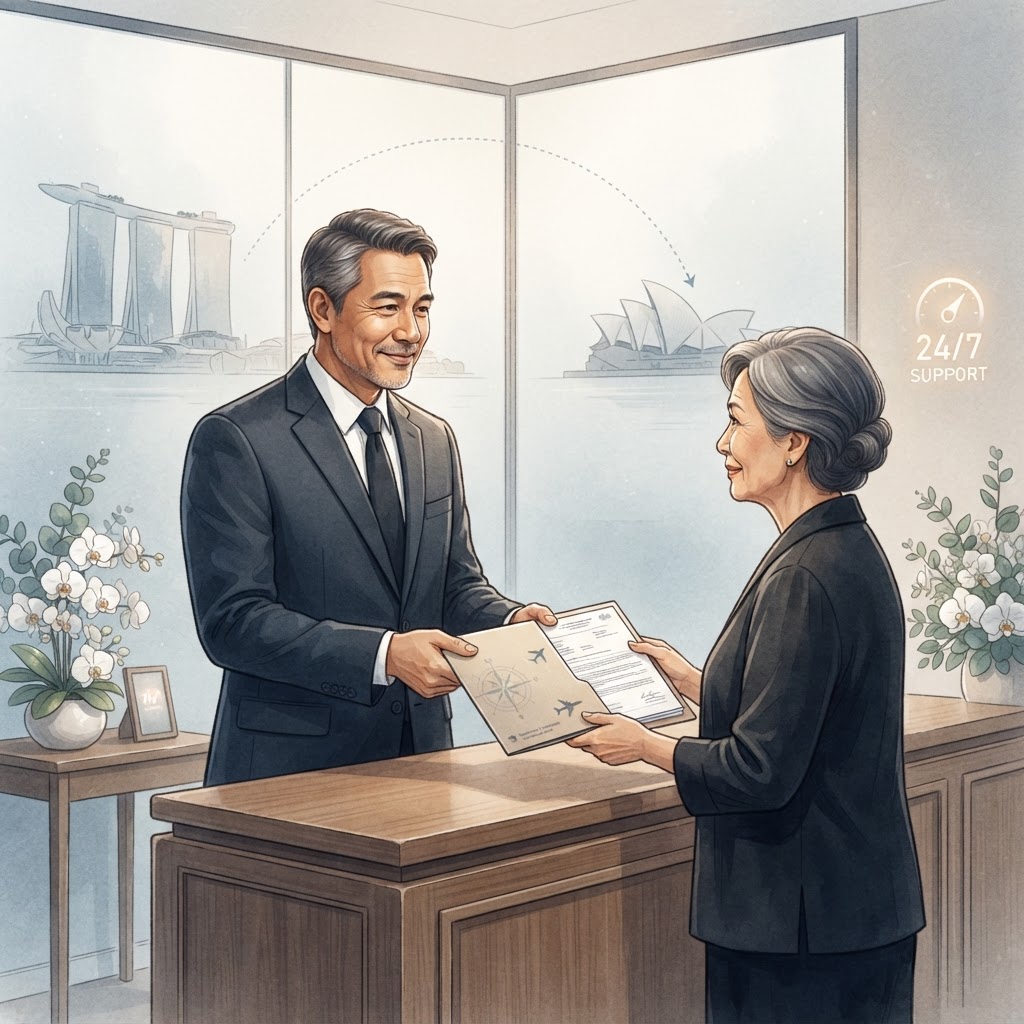
International Funeral Transport Singapore to Australia Documentation: The Essential Family Guide to a Smooth, Dignified Repatriation
When a loved one passes away overseas, grief often arrives with something else: urgent paperwork, unfamiliar procedures, and the heavy fear of getting something wrong.
For many families, the phrase “international funeral transport Singapore to Australia documentation” sounds cold and administrative. But behind every document is something deeply human: the wish to bring someone home with dignity, care, and respect.
At Eternal Horizon, we help families in Singapore manage international repatriation with calm guidance and professional precision. In this guide, we explain what documents are typically needed for funeral repatriation from Singapore to Australia, how the process usually works, what affects timelines, and how costs are calculated—so you can make clear decisions during an emotionally difficult time.
Why documentation matters more than most families expect
International repatriation is not simply a flight booking. It is a carefully coordinated process involving:
- Singapore death registration requirements
- Preparation of the deceased for transport
- Coffin and sealing requirements for air carriage
- Airline cargo arrangements
- Clearance by relevant authorities
- Arrival coordination in Australia with the receiving funeral director
Even one missing or inconsistent document can delay the journey. Names, identification numbers, and destination details must match exactly across the paperwork.
That is why experienced coordination matters so much. A professional repatriation team does not only move the deceased—they protect the family from preventable delays, confusion, and distress.
Singapore to Australia: this is usually air freight repatriation
It is important for families to understand that transport mode depends on destination.
Repatriation by land vs air
| Destination | Usual mode of transport | |---|---| | West Malaysia | Land transport via refrigerated hearse | | East Malaysia, Australia, India, China, Philippines, UK and other overseas destinations | Air freight (HUM) |
For Australia, repatriation is generally handled by air freight, often classified by airlines as Human Remains (HUM) cargo.
This means documentation, coffin preparation, airport handling, and receiving arrangements must all comply with airline and border requirements.
What documents are usually needed for international funeral transport from Singapore to Australia?
While exact requirements can vary depending on the airline, the Australian receiving state, and the individual case, families should generally expect the following documents to be required.
Core documentation checklist
| Document | Purpose | |---|---| | Death Certificate / official death registration document | Confirms the death has been officially registered | | Permit for burial / cremation or relevant local authorization where applicable | Confirms local legal handling permissions | | Embalming Certificate | Confirms preparation for international transport where required | | Coffin Sealing Certificate / Funeral Director’s Certificate | Confirms the coffin has been properly prepared and sealed for air transport | | Passport or identification document of the deceased | Used for identity verification | | Airway Bill / cargo booking documents | Required for airline cargo movement | | Receiving Funeral Director details in Australia | Needed for arrival handling and collection | | Consignee / next-of-kin documentation | Confirms who is authorized to receive or arrange the repatriation |
Additional documents may also be required in some cases
Depending on the circumstances, there may also be requests for:
- A doctor’s certificate on cause of death
- A non-contagious disease declaration, where relevant
- Translation or notarisation for certain supporting documents
- Embassy or consular documentation if nationality or legal circumstances require it
- Special clearances if there is a coroner’s case or ongoing investigation
Because each repatriation is unique, the safest approach is to let an experienced funeral repatriation provider verify the latest requirements before submission.
Step by step: how the repatriation process usually works
When families understand the sequence, the entire situation often feels less overwhelming.
1. Immediate care and first arrangements
Once we are contacted, we arrange the respectful transfer of the deceased into professional care and begin gathering the key personal and legal details.
At this stage, we help confirm:
- Full name exactly as per identification
- Nationality and passport details
- Place and date of death
- Intended destination in Australia
- Family contact person
- Receiving funeral director, if already appointed
2. Registration and document preparation
We then guide the family through the required Singapore-side paperwork and coordinate the preparation of all transport documents.
This may include:
- Securing the official death documentation
- Arranging embalming when required for air repatriation
- Preparing certification for coffin sealing and transport readiness
- Coordinating with the airline cargo department
3. Flight preparation and coffin arrangements
For air freight destinations like Australia, the deceased is placed in a coffin suitable for international transport.
Here is an important point many families do not realize:
Air freight charges are commonly calculated based on overall weight.
That means the choice of coffin can materially affect the total transport cost. Families often choose a simple, lightweight coffin for the flight, which can help reduce air freight charges significantly. If preferred, a different coffin may be selected after arrival in Australia for the funeral or final service.
This is a practical option that allows families to balance dignity, tradition, and budget responsibly.
4. Airline cargo handling and departure
Once documentation and flight arrangements are complete, the coffin is transferred for cargo acceptance and loaded for departure according to airline procedures.
Throughout this phase, careful timing is essential because cargo cut-off times, documentation checks, and operational handling can affect the confirmed flight.
5. Arrival in Australia and handover
At destination, the receiving funeral director or authorized party completes local collection and onward arrangements.
These may include:
- Airport or cargo terminal clearance
- Transfer to funeral home
- Local burial or cremation planning
- Viewing or service arrangements according to family wishes
Typical timeline: how long does it take?
No ethical funeral director should promise an unrealistic timeline before checking the case details. However, families often find this general guide helpful.
| Stage | Typical focus | |---|---| | Day 1 | First call, transfer into care, family consultation | | Day 1–2 | Document collection, registration steps, receiving side coordination | | Day 2–4 | Embalming, coffin preparation, certifications, airline booking | | Day 3–5+ | Flight departure depending on airline space, paperwork clearance, and destination arrangements |
What can affect timing?
- Weekends or public holidays
- Airline cargo space availability
- Coroner or investigation-related cases
- Delays in receiving family documents
- Differences in requirements between Australian states or receiving providers
The most reliable way to reduce delays is early, accurate coordination.
How are repatriation costs calculated?
Because every case is different, it would be misleading to quote a standard figure. Instead, families should understand the main cost components.
Costs are usually influenced by:
- Collection and local transfer in Singapore
- Care, preparation, and embalming requirements
- Type of coffin chosen for air transport
- Air freight charges based on overall weight
- Airline handling and cargo documentation
- Airport handling fees
- Administrative and permit-related work
- Receiving funeral director charges in Australia
- Any special case requirements, such as coroner or consular matters
A transparent provider should explain each component clearly and help you choose practical options without compromising dignity.
A simple family checklist before you call
To speed up arrangements, try to have these details ready if possible:
- Deceased’s full name
- Passport or identification details
- Location of the deceased in Singapore
- Next-of-kin contact details
- Destination city in Australia
- Preferred receiving funeral director, if known
- Any religious or cultural requirements
Do not worry if you do not have everything immediately. A good repatriation team will help you gather what is missing.
FAQ: international funeral transport Singapore to Australia documentation
Do all cases need embalming for transport to Australia?
For air repatriation, embalming is commonly required or expected as part of international transport preparation, subject to airline and receiving requirements.
Can we use the deceased’s existing passport?
The passport is often used as an identification document during the paperwork process, but requirements vary depending on the circumstances and current regulations.
Can the family choose a different coffin after arrival in Australia?
Yes. For air freight, many families choose a simple, lightweight coffin for the flight to reduce weight-based freight costs, then arrange a different coffin in Australia if desired.
Is this the same process as repatriation to Malaysia?
No. West Malaysia is usually handled by land transport via refrigerated hearse, while Australia is generally handled by air freight (HUM).
In a difficult moment, calm guidance makes all the difference
No family wants to become an expert in repatriation overnight. And in truth, you should not have to.
The right support means more than completing forms. It means having someone who understands the paperwork, the airline process, the receiving arrangements, and the emotional weight behind every decision.
At Eternal Horizon, we manage international funeral repatriation with discretion, accuracy, and compassion—so your loved one’s journey home is handled with the dignity they deserve.
Need immediate help?
For 24/7 assistance with international funeral transport from Singapore to Australia, contact Eternal Horizon on WhatsApp: +65 8111 1826.
We are here to guide you—carefully, clearly, and compassionately—every step of the way.