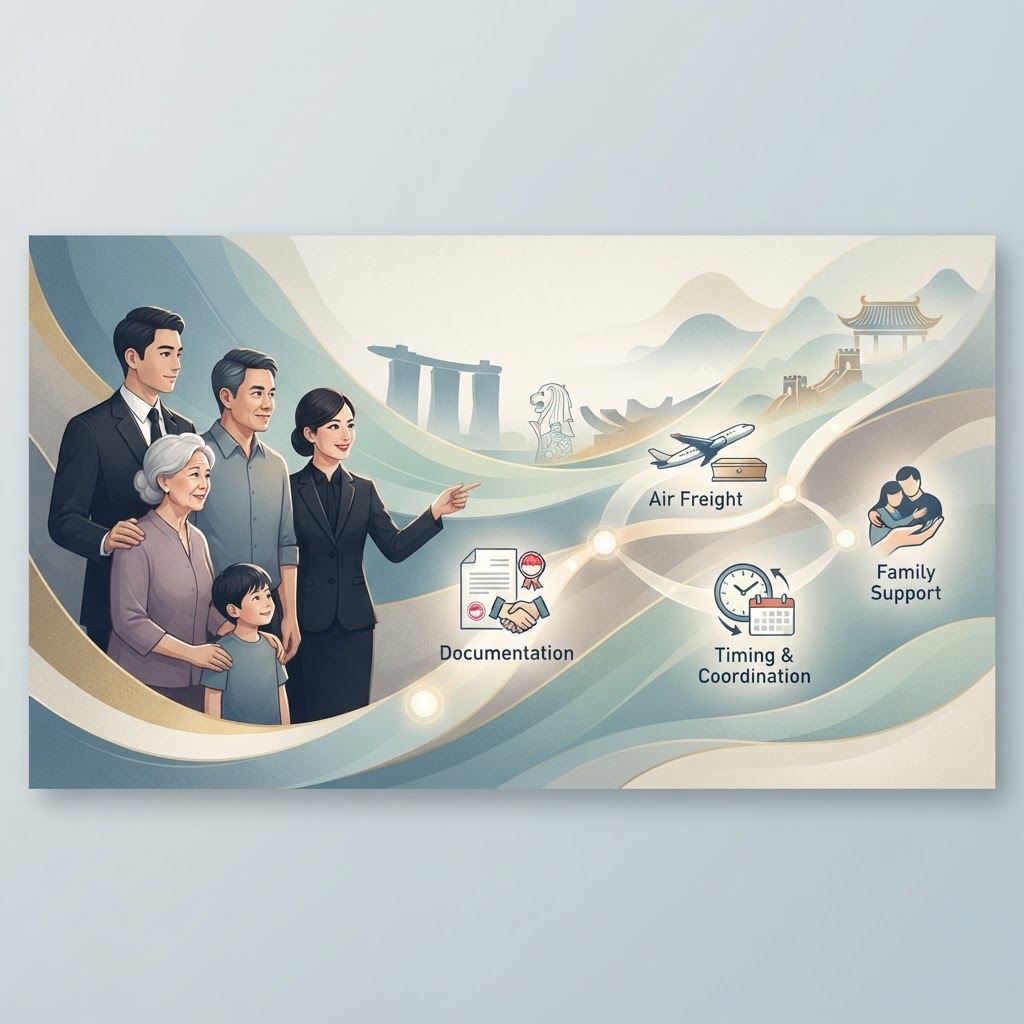
Process for Transporting Deceased from Singapore to China: A Compassionate Step-by-Step Family Guide
When a loved one passes away far from home, time can suddenly feel strange. One moment, there is disbelief. The next, there are urgent questions: What happens now? Who do we call? How do we bring them home to China with dignity?
At Eternal Horizon, we have walked beside many families during this exact moment. And while the paperwork, coordination, and airline regulations can seem overwhelming at first, the truth is this: the process for transporting deceased from Singapore to China can be managed smoothly, respectfully, and carefully when guided by an experienced repatriation team.
This guide explains what families need to know—step by step, in plain language, and with compassion.
Why Repatriation to China Requires Careful Coordination
Bringing a loved one from Singapore back to China is not simply a transport booking. It is a carefully coordinated international repatriation involving:
- Medical and legal documentation
- Preparation of the deceased for international transport
- Coffin and sealing requirements
- Airline cargo booking
- Coordination with receiving parties in China
- Timing with embassy, airline, and destination procedures
For nearby destinations such as West Malaysia, repatriation is usually done by land transport using a refrigerated hearse. However, for China, as with East Malaysia, India, the Philippines, the UK, Australia, and many other countries, repatriation is typically conducted by air freight, often booked under human remains cargo procedures.
That distinction matters, because air transport involves specific documentation, handling standards, and cargo weight calculations.
The Step-by-Step Process for Transporting Deceased from Singapore to China
1. Immediate Arrangements After the Passing
The first step is to ensure the deceased is cared for properly and transferred into professional funeral care.
Depending on where the death occurred—at home, in hospital, or elsewhere—the immediate procedure may differ slightly. In general, families should expect:
- Formal certification of death by the relevant doctor or authority
- Transfer of the deceased into a licensed care facility
- Initial collection of personal details and next-of-kin instructions
- Confirmation that the family wishes to repatriate to China
This is usually the moment when a funeral director begins coordinating the entire repatriation pathway.
2. Document Preparation: The Foundation of a Smooth Repatriation
One of the most important parts of the process for transporting deceased from Singapore to China is preparing the correct paperwork.
While exact requirements may vary depending on the province or city in China and the circumstances of death, the repatriation process commonly involves documents such as:
- Death certificate
- Permit or clearance for export of the deceased from Singapore
- Embalming certificate, where required
- Coffin-sealing or preparation certification, where required
- Passport or identification documents of the deceased
- Next-of-kin identification and authorisation documents
- Documentation required by the receiving authorities or funeral party in China
An experienced repatriation provider will carefully verify every document before the flight is booked. This is crucial, because even a minor discrepancy in names, passport details, or destination information can cause delays.
Why documentation accuracy matters so much
International transport of human remains is tightly regulated. Airlines, cargo handlers, and destination authorities must all be satisfied before the journey can proceed. Families are often surprised to learn that compassionate care and administrative precision go hand in hand.
3. Preparation of the Deceased for Air Repatriation
For repatriation from Singapore to China, transport is generally by air freight (HUM) rather than by land.
This means the deceased must be prepared in accordance with airline and destination requirements. Depending on the case, this may include:
- Hygienic care and dignified dressing
- Embalming, if required for international carriage
- Placement into a suitable coffin for air transport
- Proper sealing and external preparation for cargo handling
Every step is handled with dignity. Families often worry that international transport feels impersonal, but in reality, professional repatriation teams take extraordinary care to preserve respect at every stage.
4. Choosing the Coffin: A Practical Decision That Affects Air Freight Cost
This is one of the most important practical points families should know.
Because repatriation to China is usually by air freight, airline charges are commonly calculated based on the overall weight and shipment dimensions of the human remains consignment. In many cases, the coffin itself contributes significantly to that total.
A helpful cost-saving option
Families may choose a simple, lightweight coffin for the flight from Singapore to reduce air freight weight and therefore potentially lower transport costs. If preferred, the family can then change to a different coffin upon arrival in China for local funeral or burial arrangements.
This approach can make a meaningful difference, especially for long-haul or weight-sensitive air cargo arrangements.
The right choice depends on the family’s wishes, religious or cultural practices, airline acceptance rules, and the arrangements planned in China.
5. Airline Booking and Cargo Handling
Once documentation and preparation are in order, the flight arrangement begins.
Unlike ordinary passenger luggage, human remains are transported under specialised cargo procedures. This usually involves:
- Securing airline acceptance for the shipment
- Booking available cargo space on an appropriate route
- Coordinating with airport cargo terminals in Singapore
- Ensuring all documents accompany the shipment correctly
- Liaising with the receiving funeral agent or authorised party in China
Direct flights are often preferred where possible, as they can simplify transit handling and reduce the risk of delays. However, routing depends on airline schedules, destination airport acceptance, and documentation readiness.
6. Arrival Procedures in China
Once the flight lands, the process is not yet over. The deceased must be formally received and cleared according to local procedures in China.
This typically includes:
- Coordination with the receiving funeral home, agent, or authorised representative
- Submission of required documents to local authorities or airport cargo departments
- Release of the deceased for onward transport
- Transfer to the funeral parlour, burial location, or hometown arrangements
Because local processes may differ between cities and provinces, it is essential to have a receiving party in China who understands the local requirements.
Typical Repatriation Timeline
Below is a general guide. Actual timelines vary depending on paperwork readiness, embassy or authority processing, airline schedules, weekends/public holidays, and destination requirements.
| Stage | What Happens | Typical Consideration | |---|---|---| | Initial response | Transfer into care and family consultation | Usually begins immediately | | Documentation | Death and export-related paperwork prepared | Timing depends on case complexity | | Preparation | Embalming, coffin preparation, sealing | Scheduled after documents are in progress | | Flight booking | Airline cargo acceptance and routing | Depends on cargo space availability | | Departure from Singapore | Delivery to airport cargo terminal and uplift | Coordinated with airline cut-off times | | Arrival in China | Clearance and collection by receiving party | Varies by city and local procedure |
Family Checklist: What You May Need to Prepare
To make the process for transporting deceased from Singapore to China smoother, families are often asked to prepare or confirm the following:
- Full name of the deceased exactly as per passport/ID
- Passport or identification documents
- Next-of-kin details
- Destination city in China
- Name and contact of receiving family member or funeral representative in China
- Religious or cultural preferences
- Preferred timing, if any, for the return
- Instructions regarding coffin selection and local arrangements upon arrival
How Repatriation Costs Are Calculated
Every repatriation case is unique, so it would be misleading to quote a single standard figure.
Instead, families should understand that the total cost is usually influenced by factors such as:
- Documentation and permit requirements
- Preparation and professional care of the deceased
- Embalming or other treatment required for air transport
- Type and weight of coffin selected
- Air freight charges, often calculated based on overall shipment weight and size
- Airline route and destination airport
- Cargo terminal and handling charges
- Coordination in China, including receiving arrangements
- Timing urgency, flight availability, and special consular or local requirements
Important note on air freight cost
For air freight destinations such as China, India, the Philippines, the UK, and Australia, a lighter, simpler coffin may significantly reduce the weight-based transport component. Families who wish to do so can often select a practical flight coffin from Singapore and arrange a different coffin after arrival.
Frequently Asked Questions
Is transporting a deceased person from Singapore to China done by land or air?
For China, it is typically done by air freight (HUM). Land transport is generally relevant for nearby destinations such as West Malaysia, where a refrigerated hearse is commonly used.
How long does the process take?
It depends on documentation, flight availability, destination procedures, and whether all receiving arrangements in China are ready. An experienced repatriation team can advise based on the specific case.
Do families need to manage the airline directly?
In most cases, the funeral repatriation provider handles airline cargo coordination, documentation checks, and communication with the relevant parties.
Can we choose a different coffin in China after the flight?
Yes, in many cases families may use a simple, lightweight coffin for air transport from Singapore and then arrange a different coffin in China, depending on local plans and preferences.
A Journey Home, Handled With Dignity
There is paperwork in every international repatriation—but at the heart of it, this is not about documents. It is about bringing someone home with care, respect, and calm guidance for the family left behind.
At Eternal Horizon, we understand that the process for transporting deceased from Singapore to China is both a logistical responsibility and an emotional one. Our role is to carry that burden carefully, coordinate every detail accurately, and support your family with compassion from the first call to the final handover.
Need Immediate 24/7 Help?
If your family needs urgent assistance with repatriation from Singapore to China, contact Eternal Horizon on WhatsApp: +65 8111 1826 for immediate, round-the-clock support.
We are here to help you bring your loved one home—safely, respectfully, and without unnecessary stress.