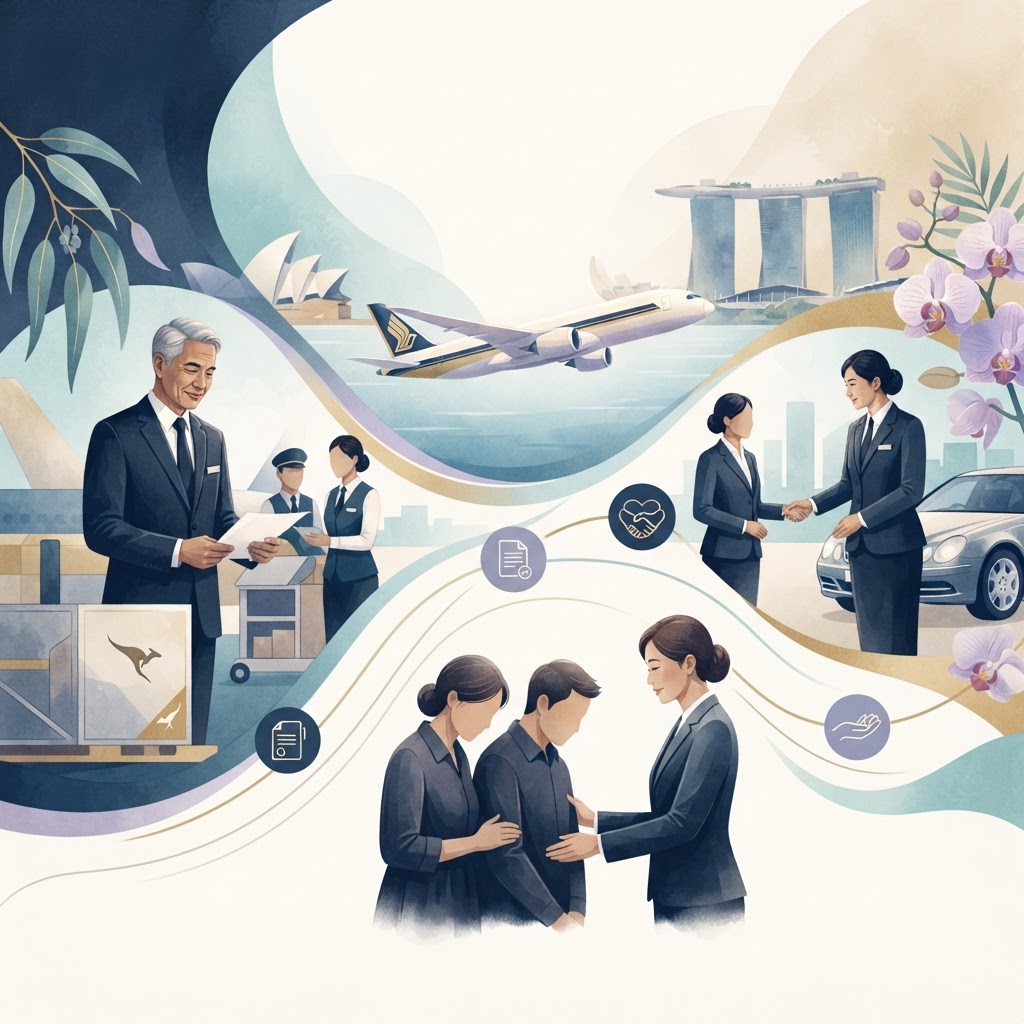
Repatriation of Remains from Australia to Singapore Process: A Compassionate Step-by-Step Guide for Families
When a loved one passes away overseas, time seems to stand still—yet suddenly, there are urgent decisions to make.
For many families, understanding the repatriation of remains from Australia to Singapore process feels like stepping into unfamiliar territory at the very moment they feel least prepared. One phone call may come from a hospital in Sydney, another from a coroner in Melbourne, and before long, questions start flooding in: What documents are needed? Who arranges the flight? How long will it take? What happens when the coffin arrives in Singapore?
The good news is this: the process is structured, manageable, and with the right funeral repatriation team, families do not need to carry the burden alone.
At Eternal Horizon, we help families in Singapore navigate international repatriation with professionalism, care, and round-the-clock support. In this guide, we explain exactly how the process works when bringing a loved one home from Australia to Singapore—clearly, compassionately, and without unnecessary complexity.
Why Repatriation from Australia to Singapore Requires Careful Coordination
Although Singapore and Australia are both highly organised jurisdictions, repatriation still involves multiple parties working in sequence:
- The hospital, nursing home, or place of passing in Australia
- The local doctor or coroner
- The Australian funeral director
- Airline cargo departments
- Singapore authorities and clearance procedures
- The receiving funeral director in Singapore
Because Australia to Singapore is an international route, the repatriation is typically done via air freight (HUM), which refers to the formal transport of human remains by air.
This is different from some regional cross-border transfers. For example:
- West Malaysia: repatriation is usually done by land transport in a refrigerated hearse
- East Malaysia, India, China, Philippines, UK, Australia, and similar destinations: repatriation is typically done by air freight (HUM)
That distinction matters because the documentation, handling, airline procedures, and cost structure are different for air transport.
The Repatriation of Remains from Australia to Singapore Process, Step by Step
1. First Notification and Immediate Coordination
The process usually begins when the family, hospital, or a contact in Australia informs a funeral repatriation provider.
At this stage, the key priorities are:
- Confirming the place and circumstances of death
- Checking whether the case has been referred to the coroner
- Identifying the next of kin and decision-maker
- Coordinating with an Australian funeral director near the place of passing
- Starting guidance for the family in Singapore
If the death is expected and medically certified, the process may move more quickly. If it is sudden, accidental, or unexplained, the coroner may need to complete investigations before release can take place.
Why this first stage matters
This is often where delays can be prevented. Early coordination helps ensure that documents, flight planning, and receiving arrangements in Singapore are all aligned from the beginning.
2. Release of the Deceased and Required Documentation
Before any international transport can happen, the deceased must be legally released and the correct documents prepared.
Common documents may include:
- Death certificate or official death registration documents
- Medical certificate of cause of death
- Coroner's clearance, if applicable
- Embalming certificate
- Coffin sealing certificate or funeral director's certification
- Passport or identification documents of the deceased
- Permit or clearance for export from Australia
- Import-related clearance documents for Singapore, where required
The exact paperwork can vary depending on:
- The Australian state or territory involved
- Whether the coroner is involved
- Airline requirements
- The final funeral or cremation arrangements planned in Singapore
A professional repatriation team will check every document carefully before shipment, because even a small discrepancy in names, dates, or document sequencing can cause avoidable delays.
3. Preparation of the Deceased for International Air Transport
For air freight (HUM), the deceased is typically prepared according to international transport and airline requirements.
This often includes:
- Professional care of the deceased
- Embalming where required for international transport
- Placement into a suitable coffin approved for air shipment
- Hermetic or secure sealing where required
- External protective packing if required by airline or route conditions
This stage is not only about compliance—it is also about dignity.
Families are often relieved to know that throughout the journey, their loved one is treated with the same respect and gentle handling that would be expected in Singapore.
A practical point families should know about coffin choice
For air freight destinations such as Singapore, East Malaysia, India, China, Philippines, UK, and Australia, air freight charges are typically calculated based on the overall weight of the shipment.
That means the coffin selected for the flight can affect the total air freight cost.
Many families do not realise they may choose:
- A simple, dignified, lightweight coffin for the international flight, which can help reduce chargeable air freight weight
- And then, if they wish, change to a different coffin upon arrival in the destination country for the wake, visitation, burial, or other final ceremony
This can be a sensible and respectful way to manage costs without compromising care.
4. Airline Booking and Cargo Handling
Once documents and preparation are complete, the shipment is booked on an available flight from Australia to Singapore.
This part includes:
- Securing cargo space with the airline
- Matching documentation to airline cargo requirements
- Coordinating airport handling times
- Ensuring the deceased is transferred to the cargo terminal correctly
- Monitoring departure and arrival details
Not every flight or airline accepts human remains in the same way, and schedules can be affected by cargo cut-off times, weekends, public holidays, or route availability.
That is why experienced coordination matters so much: a well-managed booking can make the entire process smoother for the family.
5. Arrival in Singapore and Local Clearance
When the coffin arrives in Singapore, the process is not yet over. The shipment must still go through local arrival procedures before the deceased can be brought into the care of the funeral team.
This may involve:
- Cargo arrival handling
- Verification of the accompanying documents
- Relevant local clearance formalities
- Transfer from the airport to the funeral parlour, home, or service venue
Once released, the deceased is conveyed respectfully to the next location for the family's planned arrangements.
Depending on the family's wishes, this could be for:
- Wake services
- Religious rites
- Private family viewing
- Cremation arrangements
- Burial arrangements
Typical Timeline: How Long Does It Usually Take?
Every case is different, but families often want a realistic overview. The timeline depends on documentation, the cause of death, state-specific procedures in Australia, and flight availability.
| Stage | What Happens | Typical Considerations | |---|---|---| | Initial notification | Family contacts repatriation team | Immediate, 24/7 coordination begins | | Release and documentation | Medical/coroner paperwork completed | May be faster for expected deaths, longer if coroner involved | | Preparation | Embalming, coffin preparation, sealing | Depends on appointment slots and compliance steps | | Flight booking | Cargo space secured on airline | Depends on schedule, route, and cargo cut-off | | Arrival in Singapore | Clearance and local transfer | Usually coordinated as soon as shipment lands |
A trustworthy funeral director should give families honest updates at every stage rather than unrealistic promises.
What Determines the Cost of Repatriation?
Because every case is different, it would be misleading to quote a one-size-fits-all figure. Instead, families should understand how costs are calculated.
For repatriation from Australia to Singapore, the total cost may be influenced by:
- The city or state in Australia where the death occurred
- Whether the deceased is in a hospital, mortuary, aged care facility, or coroner's care
- Whether coroner involvement creates additional waiting time or procedural steps
- Embalming and preparation requirements
- Type and weight of the coffin selected
- Airline air freight charges
- Airport handling and cargo fees
- Documentation and permit processing
- Local receiving arrangements in Singapore
- Whether wake, viewing, cremation, or burial services are required after arrival
A useful cost-saving tip
For air freight (HUM) cases, one of the most important variables is overall shipment weight. Choosing a lighter coffin for the flight can reduce the air freight component significantly. Families who prefer a different presentation coffin for the final service may arrange to change it after arrival.
This is one of the most practical ways to balance dignity and cost-awareness.
Family Checklist: What You Should Prepare
During the first call, having a few key details ready can make the process much smoother.
Helpful information to gather
- Full name of the deceased
- Passport or identification details, if available
- Location of the deceased in Australia
- Name of hospital, care facility, or authority involved
- Next of kin contact details
- Religious or cultural requirements
- Preferred final arrangement in Singapore
- Any urgent family timing considerations
| Checklist Item | Why It Helps | |---|---| | Deceased's full details | Reduces document errors | | Location in Australia | Helps appoint the nearest funeral partner | | Passport/ID copy | Supports identity verification and paperwork | | Next of kin details | Clarifies legal authority and communication | | Final wishes | Helps plan receiving arrangements in Singapore |
Frequently Asked Questions
Is repatriation from Australia to Singapore always by air?
Yes, for this route, repatriation is generally arranged via air freight (HUM).
Can the family choose cremation in Australia instead of bringing the deceased home?
Yes, some families may choose local cremation and transport of ashes instead. The best option depends on religious, emotional, legal, and practical considerations.
Will embalming be required?
For international transport of remains by air, embalming is commonly required as part of the preparation and compliance process, subject to local and airline requirements.
Can we use a simple coffin for the flight and a different coffin later in Singapore?
Yes. For air freight shipments, many families choose a simple, lightweight coffin for transport and then change to another coffin in Singapore for the final service if preferred.
Bringing Someone Home Is More Than Logistics
At first glance, the repatriation of remains from Australia to Singapore process may seem like a maze of documents, airport procedures, and coordination calls. But at its heart, it is something much more human: it is the act of bringing a loved one back to the people and place that matter most.
That journey deserves precision, gentleness, and genuine care.
At Eternal Horizon, we support families through every stage—from the first urgent phone call to the safe arrival in Singapore and the final arrangements that follow. If you need immediate guidance, compassionate advice, or 24/7 assistance with international repatriation, we are here to help.
Contact Eternal Horizon on WhatsApp at +65 8111 1826 for immediate 24/7 assistance.