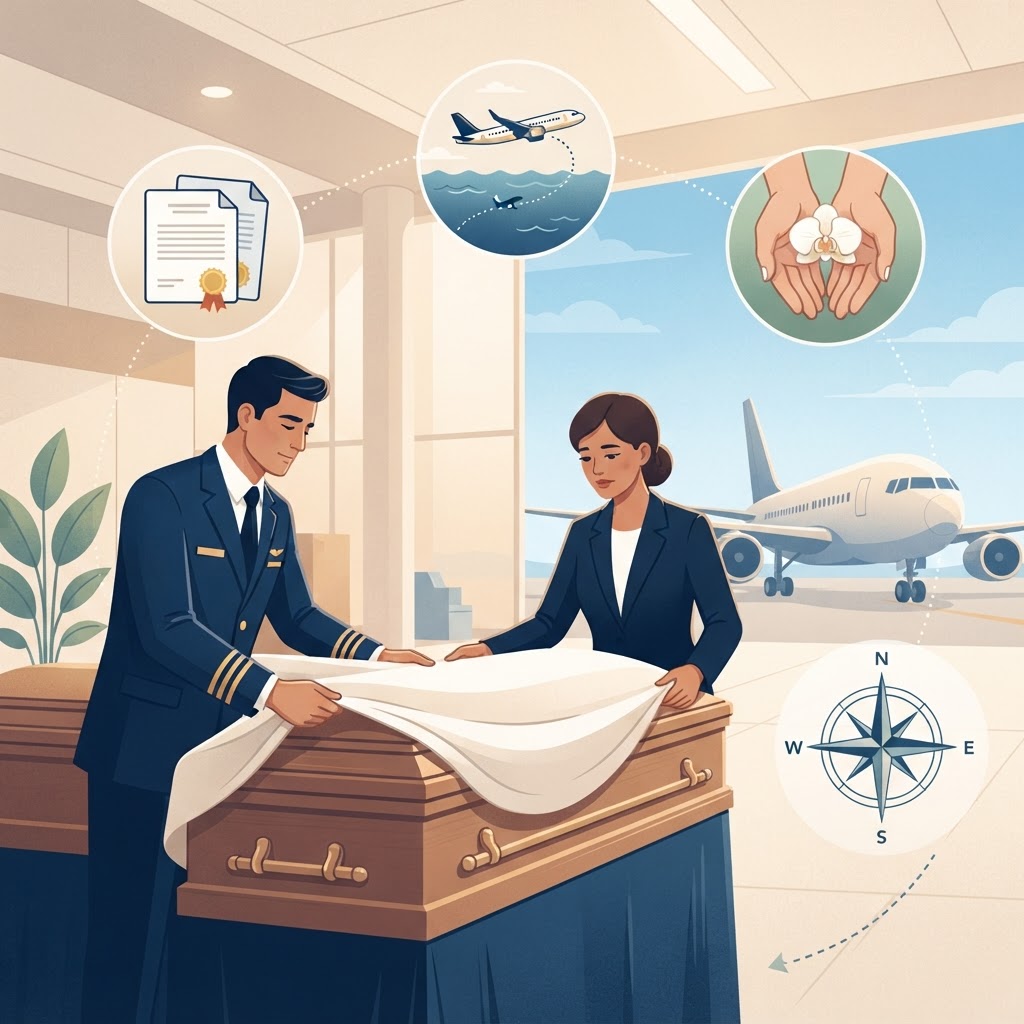
Requirements for Transporting Deceased from Singapore to Philippines: A Compassionate Step-by-Step Guide for Families
When a loved one passes away far from home, the first questions often arrive all at once: What happens next? Who do we call? How do we bring them home to the Philippines with dignity and without delay?
At Eternal Horizon, we understand that repatriation is never just paperwork and logistics. It is a final journey filled with love, urgency, cultural care, and a family’s deep wish to reunite with someone precious. If you are searching for the requirements for transporting deceased from Singapore to Philippines, this guide will walk you through the process clearly, compassionately, and accurately.
Why Repatriation to the Philippines Is Usually by Air Freight
One of the most important distinctions families should understand is how repatriation is carried out depending on the destination.
- West Malaysia: transport is usually by land, typically using a refrigerated hearse.
- Philippines, East Malaysia, India, China, UK, Australia, and many other overseas destinations: transport is typically by air freight (HUM).
For the Philippines, the deceased is generally transported as human remains cargo by air. This means airline regulations, cargo documentation, embalming requirements, coffin specifications, and receiving arrangements in the Philippines must all be coordinated properly.
That may sound overwhelming—but with experienced handling, it becomes a structured, respectful process.
The Main Requirements for Transporting Deceased from Singapore to Philippines
While each case can vary slightly depending on the circumstances of death, airline, and receiving city in the Philippines, families should generally expect the following requirements.
1. Death Registration in Singapore
Before any international repatriation can begin, the death must be properly registered in Singapore.
This typically involves:
- Medical certification of the death
- Official death registration
- Issuance of the Singapore death certificate
This document is foundational, as it will be needed for permit applications and coordination with the Philippine side.
2. Embalming and Preparation of the Deceased
For air transport to the Philippines, embalming is generally required. The deceased must be prepared for international carriage according to health, airline, and destination regulations.
This usually includes:
- Professional embalming
- Hygienic preparation and dressing
- Placement into a suitable coffin or casket for air shipment
- Sealing requirements where applicable
Care during this stage is deeply important. Families often find comfort in knowing that every preparation is performed with dignity and respect.
3. Coffin or Casket Suitable for Air Freight
Because repatriation to the Philippines is by air freight, the coffin selected affects not only presentation but also logistics.
A key point families should know:
Air freight charges are generally calculated based on overall weight.
That means a heavier, more elaborate coffin can significantly increase air cargo charges. Many families choose a simple, lightweight coffin for the flight to help manage air freight costs, and then change to a different coffin upon arrival in the Philippines if preferred for the wake or final funeral service.
This is often a practical and respectful choice, especially when the family wants to balance dignity with cost awareness.
4. Sealing Certificate / Embalming Certificate
Airlines and receiving authorities usually require documentation confirming that the deceased has been properly embalmed and that the coffin has been prepared for transport.
This may include:
- Embalming certificate
- Sealing certificate or equivalent funeral preparation certification
Exact document names can vary depending on the funeral provider and airline handling requirements.
5. Export Permit / Clearance from Singapore Authorities
To move human remains out of Singapore, the necessary export or removal clearances must be obtained.
This may involve coordination with relevant Singapore authorities and airport cargo procedures. Professional funeral repatriation teams typically arrange this on behalf of the family.
6. Consular or Receiving-Side Documentation
Depending on the case, repatriation may also require supporting documentation for acceptance into the Philippines. Requirements can vary based on:
- The city or province of final destination
- The receiving funeral home
- Airline route and transit points
- Philippine government or local health requirements in force at the time
This is why careful case-by-case verification is essential.
Step-by-Step: How the Repatriation Process Usually Works
Here is how the journey typically unfolds.
Step 1: Immediate Collection and Care
- Transfer the deceased from hospital, home, or mortuary
- Provide professional shelter care
- Verify family instructions and religious or cultural preferences
Step 2: Documentation Review
- Confirm the death certificate and registration details
- Check passport or identification of the deceased
- Prepare the paperwork required for export and airline booking
- Coordinate with the receiving family or funeral director in the Philippines
Step 3: Embalming and Coffin Preparation
- Embalm and prepare the deceased for air transport
- Place the deceased into an air-freight suitable coffin
- Complete sealing and preparation certificates
Step 4: Flight and Cargo Booking
- Secure suitable airline cargo space for HUM (human remains)
- Confirm cargo acceptance timing
- Coordinate transit requirements if there is no direct routing
Step 5: Departure from Singapore
- Transport the coffin to the airport cargo terminal
- Submit the required cargo and regulatory documents
- Complete final export handling procedures
Step 6: Arrival in the Philippines
- Receiving party clears the remains with local authorities and cargo handling
- The deceased is transferred to the local funeral home or final destination
- Funeral, wake, burial, or cremation arrangements proceed in the Philippines
Typical Documents Checklist
Below is a simple overview families often find helpful.
| Document / Requirement | Why It Matters | Usually Needed | |---|---|---| | Singapore death certificate | Confirms official death registration | Yes | | Passport/ID of the deceased | Identity verification | Commonly required | | Embalming certificate | Confirms preparation for air transport | Yes for air freight cases | | Coffin sealing/preparation certificate | Supports airline and cargo acceptance | Commonly required | | Export/removal clearance | Permits departure from Singapore | Yes | | Flight cargo booking (HUM) | Secures air transport | Yes | | Receiving party details in the Philippines | Ensures proper handover on arrival | Yes |
Important: Exact documentation can differ depending on the specific circumstances, airline, route, and local receiving requirements in the Philippines.
How Long Does It Take?
Families often ask this first—and understandably so.
While every case is different, the timeline usually depends on:
- How quickly documents are available
- Whether the death was from natural causes or requires further investigation
- Airline cargo space availability
- Transit routing and destination airport procedures in the Philippines
- Whether the receiving party is ready for arrival clearance
Simple Timeline Overview
| Stage | Typical Consideration | |---|---| | Death registration | Must be completed first | | Embalming and preparation | Scheduled after documentation is in order | | Permit and cargo processing | Depends on authority and airline requirements | | Flight departure | Based on cargo space and routing | | Arrival and clearance in the Philippines | Depends on local handling and receiving arrangements |
A professional repatriation team helps reduce avoidable delays by coordinating all parties closely from the start.
How Are Costs Calculated?
Because every repatriation is unique, it would be misleading to quote a generic figure. Instead, families should understand what makes up the total cost.
Common cost components include:
- Collection and local transfer in Singapore
- Shelter and care of the deceased
- Embalming and preparation
- Coffin or casket selected for transport
- Documentation and permit processing
- Airport handling and cargo arrangements
- Air freight charges, which are usually based on overall weight
- Receiving-side handling in the Philippines, if included in the arrangement
A practical cost-saving tip for air freight cases
For destinations like the Philippines, where transport is by air freight (HUM), choosing a simple, lightweight coffin for the flight can reduce cargo costs significantly. If the family prefers, a different coffin can be arranged after arrival in the Philippines for the wake or funeral service.
This is one of the most important and often overlooked ways to manage repatriation expenses sensibly.
FAQ: Requirements for Transporting Deceased from Singapore to Philippines
Is repatriation to the Philippines done by land or air?
It is typically done by air freight (HUM), not by land.
Is embalming required?
For international air transport of human remains, embalming is generally required.
Can the family use any coffin?
The coffin must be suitable for international air shipment and airline handling requirements. A lightweight option is often chosen for the flight.
Can a heavier or decorative coffin increase the total cost?
Yes. For air freight destinations, cargo costs are generally affected by overall weight, so a heavier coffin can increase charges.
Can the coffin be changed after arrival in the Philippines?
Yes, in many cases families choose a simple air-transport coffin from Singapore and arrange a different coffin upon arrival in the Philippines.
A Final Word for Families Facing This Journey
There is nothing easy about arranging the final journey of someone you love. But there is comfort in knowing that the path home can be handled with order, dignity, and genuine care.
At Eternal Horizon, we support families through every stage of the repatriation process—from documentation and embalming to flight coordination and receiving arrangements—so that your loved one’s return to the Philippines is carried out respectfully and without unnecessary stress.
If you need immediate 24/7 assistance with the requirements for transporting deceased from Singapore to Philippines, contact Eternal Horizon on WhatsApp: +65 8111 1826. We are here to help, day and night, with compassion, clarity, and experienced guidance.