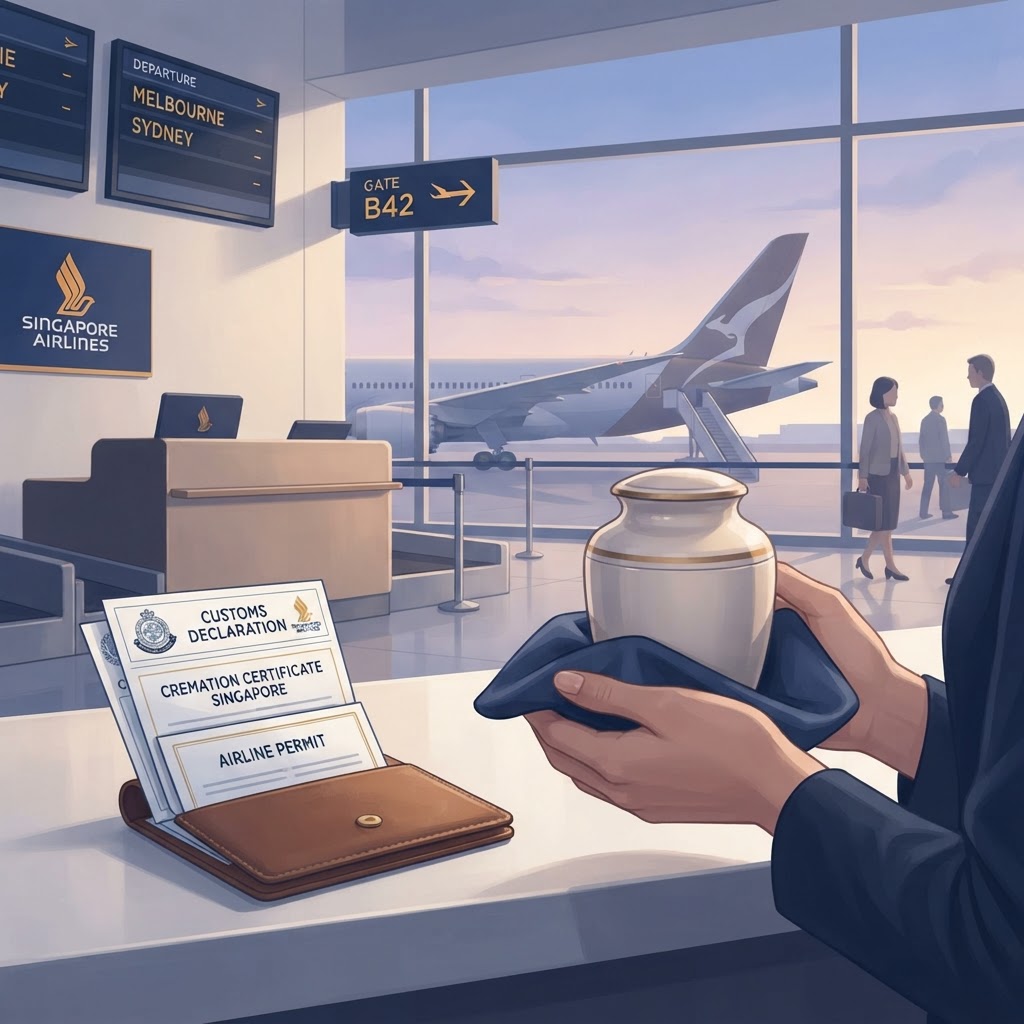
Transporting Ashes from Singapore to Australia: Regulations, Documents & a Stress-Free Step-by-Step Guide
When a loved one’s final journey crosses borders, even a small urn can suddenly feel surrounded by big questions.
Can ashes be taken into Australia?
Do you need a permit?
Will the airline allow them in cabin baggage or must they be checked in?
What documents should you prepare from Singapore?
If you are searching for clear answers on transporting ashes from Singapore to Australia regulations, you are not alone. Many families come to us in the middle of grief, worried about making a mistake at the airport, being delayed at customs, or unknowingly missing a critical document.
At Eternal Horizon, we handle these moments with care, clarity, and deep respect. In this guide, we walk you through what families generally need to know when bringing cremated remains (ashes) from Singapore to Australia—so you can focus on honouring your loved one, not navigating uncertainty alone.
The Short Answer: Can You Bring Ashes from Singapore to Australia?
Yes—cremated remains can generally be transported from Singapore to Australia, provided they are properly packed and accompanied by the appropriate documentation.
In many cases, ashes are simpler to transport than a full-body repatriation because they do not require embalming, a zinc-lined coffin, or air freight handling as human remains (HUM). However, “simpler” does not mean “informal.” Airlines may have their own handling rules, and documentation still matters.
Important distinction:
- Malaysia (West): Repatriation of a deceased person is usually by land transport using a refrigerated hearse.
- East Malaysia, Australia, India, China, the Philippines, the UK, and similar destinations: Repatriation of a deceased person is usually by air freight under HUM procedures.
- Ashes, however, are typically transported with the family or arranged in accordance with airline and customs requirements, rather than as full-body HUM cargo.
Why Families Often Feel Overwhelmed
A common scenario looks like this: the cremation has taken place in Singapore, relatives in Australia are waiting, flights are being discussed, and suddenly everyone is hearing different advice from different sources.
One person says ashes can go in hand luggage. Another says they must be checked in. Someone else mentions customs declarations. By then, what should be a peaceful act of bringing someone home starts to feel stressful.
That is why the safest approach is always this:
- Prepare the correct Singapore-issued documents
- Use a suitable urn or container
- Check directly with the airline before travel
- Ensure the remains can be identified and presented respectfully if requested
What Regulations Matter Most for Transporting Ashes from Singapore to Australia?
While requirements can change and individual circumstances differ, families should pay closest attention to the following areas:
1. Documentation from Singapore
You will typically want a complete document set showing:
- The identity of the deceased
- That the deceased was lawfully cremated in Singapore
- That the contents of the urn are cremated remains
Commonly relevant documents may include:
- Death Certificate
- Cremation Certificate
- Letter from the funeral director or crematorium, where appropriate, confirming the urn contains cremated remains
- Identification details of the person carrying the ashes
If documents are incomplete, unclear, or inconsistent, this can lead to avoidable delays.
2. Airline Rules
Airlines do not all operate the same way. Some may allow ashes in cabin baggage, while others may require them in checked baggage subject to packaging conditions.
Key airline considerations include:
- Whether ashes are allowed in hand-carry luggage
- Whether the urn must pass security screening
- Whether the container material is suitable for X-ray inspection
- Whether advance notification is recommended or required
A container that cannot be clearly screened may cause issues at security. For this reason, many families choose a non-metal, security-friendly urn or temporary container for travel.
3. Australian Border and Entry Expectations
Australia is known for strong border control standards. Although cremated remains are generally allowed entry, travellers should still be prepared to:
- Declare the ashes if required
- Present supporting documents if asked
- Ensure the remains are cleanly and securely packed
Because border procedures can vary depending on the route, airport, and officer assessment, proper paperwork is your best protection against disruption.
Step-by-Step: How to Transport Ashes from Singapore to Australia Smoothly
Step 1: Obtain the official cremation documents
Before any travel booking, confirm that you have the full supporting paperwork from Singapore.
Checklist:
- Death Certificate
- Cremation Certificate
- Funeral director or crematorium confirmation letter, if available
- Passport copy or identification of the accompanying traveller
Step 2: Choose a travel-suitable urn
Not every urn is ideal for air travel.
A suitable travel urn should be:
- Securely sealed
- Durable but lightweight
- Preferably non-metallic or easily scannable
- Properly labelled, where appropriate
If the family prefers a decorative urn for final placement in Australia, it may be wiser to use a simple travel urn first, then transfer the ashes later.
Step 3: Check the airline’s current policy
Before departure, contact the airline and ask:
- Can ashes travel in cabin baggage?
- Are there packaging restrictions?
- Do documents need to be shown at check-in?
- Is prior approval or notation on the booking recommended?
Step 4: Prepare for airport screening
At security or check-in, stay calm and keep all documents easily accessible.
Helpful tips:
- Carry documents in a clear folder
- Inform staff respectfully if you are carrying cremated remains
- Avoid sealing documents deep inside checked baggage
Step 5: Arrive in Australia with documents ready
Upon arrival, follow any declaration requirements and keep the urn closed and respectfully handled.
A Simple Travel Timeline
| Stage | What to Do | Why It Matters | |---|---|---| | Before booking flights | Gather cremation and death documents | Prevents last-minute complications | | Before departure | Confirm airline rules for ashes | Policies vary between carriers | | Packing stage | Use a secure, lightweight, scannable urn | Reduces screening issues | | Airport day | Keep documents in hand | Speeds up check-in and security queries | | Arrival in Australia | Be ready to present documents if requested | Helps ensure smooth entry |
What About Costs?
Families often ask for a price immediately, but with cross-border arrangements, specific quotes should never be guessed or generalized.
For ashes transport, costs may depend on factors such as:
- Whether the family is personally carrying the ashes or asking a professional team to coordinate the transfer
- Airline baggage or handling requirements
- Type of urn or temporary travel container used
- Document preparation or notarisation needs, if any
- Collection, delivery, or administrative coordination services
For full-body repatriation by air freight (HUM) to destinations such as Australia, India, China, the Philippines, the UK, and East Malaysia, costs are typically influenced heavily by overall weight.
That is why families should know this practical point:
Choosing a simple, lightweight coffin for the flight can significantly reduce air freight costs, because airline cargo charges for HUM cases are often based on overall weight. If the family prefers a different coffin for ceremonies at the destination, it is often possible to change to another coffin upon arrival.
This distinction is especially important when comparing air repatriation of a body versus transporting ashes, as the logistics and cost structure are very different.
Common Mistakes to Avoid
Assuming all airlines have the same rule
They do not. Always verify with the actual carrier.
Using a heavy metal urn without checking screening compatibility
If airport security cannot properly screen the urn, delays may occur.
Travelling without the cremation certificate
Even if not requested, it is one of the most important supporting documents.
Leaving arrangements to the last minute
Grief already creates enough pressure. Early coordination prevents unnecessary distress.
FAQ: Transporting Ashes from Singapore to Australia Regulations
Do I need a permit to bring ashes into Australia?
In many cases, cremated remains can be brought in with proper documentation, but requirements may vary depending on circumstances and handling arrangements. Always check current airline and Australian entry requirements before travel.
Can I carry ashes in my hand luggage?
Possibly, but this depends on the airline and airport security requirements. Always confirm in advance.
What is the most important document?
The Cremation Certificate is one of the most important documents, usually together with the Death Certificate.
Is carrying ashes easier than full-body repatriation?
Yes, generally. Full-body repatriation to Australia is usually arranged by air freight under HUM procedures, while ashes are usually less complex to transport—but still require proper preparation.
A Gentle Final Word
Behind every urn is a life, a story, and a family trying to do one last thing with love.
Understanding transporting ashes from Singapore to Australia regulations is not only about compliance—it is about making sure your loved one’s final journey is handled with dignity, calm, and care. With the right documents, the right container, and the right guidance, the process can be far smoother than many families fear.
If you need immediate help, personalised guidance, or full assistance coordinating documents and travel arrangements, Eternal Horizon is here for you 24/7.
WhatsApp us anytime: +65 8111 1826
We will guide you step by step, with compassion and professionalism.